Healthcare CRM platforms play an important role in this transformation by helping teams manage enquiries, assign leads, coordinate follow-ups, monitor appointments, and track patient acquisition activities.
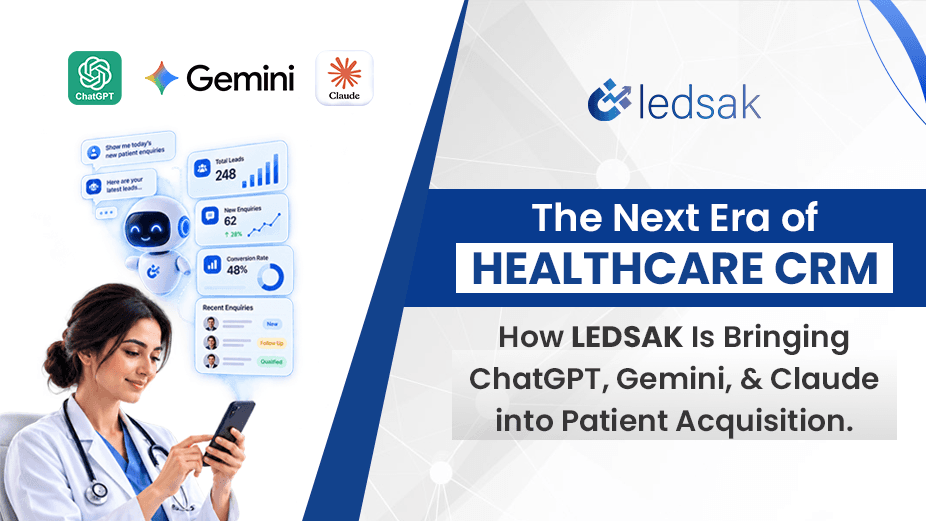
LEDSAK is entering this evolving landscape with its integrations with ChatGPT, Google Gemini, and Claude. These integrations create opportunities to explore how generative AI can complement healthcare-focused CRM workflows and support the teams responsible for moving enquiries towards appointments.
But what does this mean for healthcare businesses? How can AI platforms work alongside a healthcare CRM, and what should organisations consider before adopting these capabilities?
What Is Changing in Healthcare CRM with AI Integration?
Traditional CRM systems help healthcare teams organise enquiry details, assign leads, track communication, and monitor the progress of prospective patients. However, teams also spend time drafting messages, preparing reports, organising information, and maintaining consistent communication across departments.
AI introduces another layer of assistance. Depending on the platform and its configuration, AI tools can help users generate content, summarise information, structure documents, and explore ways to improve repetitive administrative tasks.
When these capabilities complement healthcare CRM workflows, organisations can explore a more connected approach to patient acquisition.
For example, a fertility centre may receive enquiries about different treatment options. Its healthcare CRM can help track each enquiry and its follow-up status, while an approved AI workflow may assist staff in drafting a general response for review.
LEDSAK focuses on healthcare CRM and Patient Acquisition Management, supporting the operational journey from enquiry management and follow-ups to appointment coordination and outcomes.
The opportunity is to connect AI assistance with structured healthcare lead management without treating AI as a replacement for the CRM or human decision-making.
How Do ChatGPT, Gemini, and Claude Fit into LEDSAK?
ChatGPT, Google Gemini, and Claude are separate AI platforms with different capabilities. Their potential applications depend on the model, access permissions, and functionality enabled through each integration.
| AI Platform | Potential Role in Healthcare Workflows | Example Application |
|---|---|---|
| ChatGPT | Content generation and information structuring | Drafting enquiry-response templates and internal communication |
| Google Gemini | Content assistance and information processing | Preparing structured operational notes and communication drafts |
| Claude | Document assistance and structured writing | Developing internal workflow documentation and SOP drafts |
These are illustrative use cases, not a guarantee that every capability is available inside LEDSAK. The actual features should be verified against the live integration.
Why Connect Multiple AI Platforms Instead of Relying on One?
Different tasks may require different approaches to writing, analysis, and information processing. Access to multiple AI platforms can give teams flexibility to explore which tool suits a particular task.
However, connecting three AI platforms does not automatically mean they share information with one another, access the same CRM records, or perform actions independently.
The value depends on how the integrations are implemented and how healthcare teams incorporate them into their daily processes.
How Can AI Platforms Connect with LEDSAK Healthcare CRM?
How Can AI Integration Support Different Stages of Patient Acquisition?
Patient acquisition is a journey that begins with an enquiry and may progress through follow-ups, appointment scheduling, and further communication. Each stage requires coordination between technology and people.
1. How Can AI Help Teams Manage Healthcare Enquiries?
Healthcare organisations receive enquiries through websites, digital campaigns, messaging channels, and other sources. Keeping these enquiries organised is essential for timely follow-up.
A healthcare CRM can help centralise lead information, assign responsibility, and track progress. AI may complement this process by helping staff prepare response templates, organise non-sensitive information, or improve the clarity of general communication.
For example, a clinic could use an approved AI tool to draft a response to a general question about consultation availability. Staff would verify the information and communicate through the appropriate channel.
2. Can AI Help Improve Follow-Up Management?
Follow-ups are an important part of healthcare lead management. Delayed responses or unclear ownership can make it difficult for teams to maintain consistent communication.
AI can help draft follow-up messages and standardise communication templates. Meanwhile, CRM workflows can help teams track which enquiries require attention and when the next action is due.
Drafting a message with AI is not the same as automatically sending it. Automatic sending, scheduling, or record updates depend on the features and permissions actually configured.
3. How Can AI and CRM Support Appointment Coordination?
Appointment coordination involves communicating relevant information, checking availability, and keeping enquiry status up to date.
A healthcare CRM can help staff monitor appointment-related workflows. AI may provide additional assistance with administrative tasks, such as drafting appointment instructions or preparing general communication for staff review.
Direct access to appointment calendars, live availability, or automatic booking should only be claimed if those capabilities are confirmed for the specific integration.
4. Can AI Help Healthcare Teams Understand Lead Management Performance?
Healthcare managers need a clear understanding of enquiry volumes, follow-up activity, appointment progress, and operational bottlenecks.
A CRM can provide structured records and reports, depending on the available reporting features. AI may help users interpret approved, appropriately anonymised information or develop questions for further analysis.
For instance, a manager could investigate whether enquiries are being followed up within the clinic's target timeframe and identify possible reasons for delays.
AI-generated interpretations should be checked against the underlying data. They should not be treated as proof of improved conversion rates or clinical outcomes without supporting evidence.
How Can AI-Connected Healthcare CRM Change Daily Clinic Operations?
AI integration becomes valuable when it helps teams move beyond collecting leads and start understanding what happens after an enquiry. For clinic owners, managers, front-desk teams, and marketing professionals, the practical benefits may differ according to their responsibilities.
The following table illustrates potential changes in daily operations. Actual results depend on LEDSAK's enabled features, data availability, and configuration.
| Who Benefits? | Before an AI-Assisted Workflow | Potential Improvement with LEDSAK and AI |
|---|---|---|
| Doctor-owner | Requests reports from the manager and may receive delayed or summarised numbers | Can explore available reports and ask questions about performance where live data access is supported |
| Clinic manager | Spends considerable time compiling Excel reports | Can focus more on investigating report findings and improving operational processes |
| Tele-callers and front desk | Follow-ups may be missed when the team is busy | Configured lead tracking and alerts can help identify untouched or overdue leads |
| Multi-branch healthcare group | Branches may report performance using different formats | Standardised reporting can make branch-level comparisons easier when consistent data is available |
| Marketing team or agency | Campaigns may be evaluated mainly on enquiry volume | Can assess appointments and collected revenue by source when reliable attribution and revenue data are tracked |
Why Does Speed Matter in Healthcare Lead Management?
A person enquiring about a consultation may be comparing several providers before deciding whom to contact. Delayed communication can make it harder for a clinic to maintain engagement.
A structured healthcare CRM helps teams identify new enquiries, track follow-up status, and assign responsibility. AI-assisted reporting may further help authorised users identify where leads are waiting for action, provided the integration has access to the relevant information.
The objective is not simply to respond faster. It is to create a more consistent process from the first enquiry through follow-up and appointment coordination.
For healthcare businesses, this means evaluating both the speed of follow-up and the quality of communication while respecting each person's preferences and privacy.
Healthcare CRM vs AI Platforms: What Is the Difference?
AI platforms and healthcare CRM systems serve complementary purposes. Understanding the difference helps organisations choose the right tool for each task.
| Business Requirement | Healthcare CRM Such as LEDSAK | AI Platforms Such as ChatGPT, Gemini, and Claude |
|---|---|---|
| Lead tracking | Maintains structured lead records and statuses | May help organise or interpret approved information |
| Lead assignment | Supports configured assignment workflows | May assist with drafting assignment rules or instructions |
| Follow-up management | Tracks activities and configured reminders | Can help prepare communication drafts |
| Appointment progress | Helps teams monitor configured appointment workflows | Can assist with general administrative content |
| Documentation | Organises information through available features | Helps draft and structure documents |
| Operational reporting | Provides access to configured CRM reporting | May help analyse supplied information, subject to the tool's capabilities |
What Are the Potential Benefits of AI-Connected Healthcare CRM?
When implemented carefully, AI-assisted workflows may offer several operational benefits.
More consistent communication: Teams can create and review standardised message templates.
Reduced repetitive drafting: Staff may spend less time preparing routine text and internal documents.
Clearer workflows: CRM records and configured reminders help teams understand which actions are pending.
Flexible task support: Organisations can evaluate different AI models for appropriate use cases.
Improved process visibility: Structured CRM data can help managers identify workflow gaps and investigate operational issues.
These benefits are potential outcomes, not guaranteed results. Actual performance depends on the integration, data quality, staff training, workflow design, and how effectively the organisation uses the tools.
Patient Data, Privacy, and Security: Who Stays in Control?
Healthcare data is sensitive. Connecting an AI assistant to a healthcare CRM requires clear access controls, appropriate permissions, and an understanding of how information is processed.
When integrating ChatGPT, Google Gemini, or Claude with LEDSAK, healthcare organisations should consider the following principles:
Role-based access: Users should access only the clinic information permitted by their assigned roles and permissions.
Data privacy: Share only the information necessary for the task. Avoid entering patient names, contact details, or clinical notes into unapproved AI tools.
Controlled actions: Distinguish between read-only reporting and actions that modify CRM records. Apply confirmation and approval controls where supported.
AI subscriptions and data policies: Verify whether the integration uses an individual account, an API, or another connection method. Review the applicable provider's data-use and retention terms.
Human oversight: Review AI-generated reports, summaries, and communication before relying on them for operational decisions or patient-facing use.
Data security and compliance: Confirm access controls, security safeguards, and applicable privacy requirements before enabling an AI workflow.
Accuracy and accountability: Verify important figures and keep authorised staff responsible for decisions and actions.
The safest starting point is to use aggregate numbers, lead stages, appointment counts, and appropriately anonymised reports wherever practical, rather than identifiable patient details.
Integration alone does not establish regulatory compliance. Healthcare organisations should assess the complete workflow and obtain appropriate security, privacy, and legal guidance where necessary.
For additional guidance, consult andAnthropic API data-retention documentation. Policies vary by service and account type.
How Can Healthcare Organisations Get Started with LEDSAK's AI Integrations?
Adopting AI does not require changing every existing process at once. Healthcare businesses can begin with a clearly defined workflow, test it under controlled conditions, and expand only after validating the results.
Step 1: Identify a Specific Healthcare Workflow
Start by identifying a repetitive, well-defined task.
Examples include:
Preparing general enquiry-response templates.
Drafting follow-up communication for staff review.
Creating internal SOPs for lead handling.
Structuring non-sensitive operational documentation.
Preparing summaries from approved, anonymised information.
Choose a task with a clear purpose and a measurable way to assess its usefulness.
Step 2: Confirm the Available LEDSAK Integration Features
Contact the LEDSAK team to confirm how ChatGPT, Gemini, and Claude are integrated and what each connection supports.
Ask whether the setup involves an API, a connector, or another integration method. Confirm whether users can exchange prompts and responses only, access selected CRM information, trigger workflows, or perform authorised actions.
Do not assume that every AI model has identical capabilities or permissions.
Step 3: Define Data Access and Permissions
Before connecting AI to healthcare workflows, decide what information the system is permitted to process.
Identify whether the workflow involves personal or sensitive patient information.
Confirm which AI service, account, and integration configuration are approved.
Define access permissions and the minimum data required for the task.
Review applicable privacy, security, and retention requirements.
Establish who can approve outputs and initiate any resulting action.
For initial testing, use synthetic or appropriately anonymised information wherever practical.
Step 4: Configure and Test the Workflow
Work with the relevant technical or product team to configure the approved connection.
Test the workflow using controlled examples. Check whether the AI output is accurate, whether information is passed to the correct destination, and whether the system behaves as expected when information is missing or incorrect.
Where the workflow can change CRM records or send communications, test permissions and approval steps before enabling it for routine use.
Step 5: Keep Human Review in the Process
AI-generated content can contain errors, omit context, or produce unsuitable wording. Establish a review process for patient-facing communication and operational decisions.
Healthcare professionals must retain responsibility for clinical advice, diagnosis, and treatment-related decisions. AI-generated content should not be presented as a substitute for professional judgement.
Step 6: Measure the Results
Define success criteria before deploying the workflow.
Useful operational measures may include:
Time taken to prepare approved communication drafts.
Percentage of enquiries receiving follow-up within the organisation's target timeframe.
Frequency of errors or revisions in AI-generated content.
Staff adoption and feedback.
Changes in lead-stage completion or appointment coordination.
Compare results with a reliable baseline and account for other factors that may influence performance. Avoid claiming improvements in conversion or patient outcomes unless the data supports those conclusions.
Step 7: Expand Gradually
Once the first workflow has been validated, assess whether additional use cases would be valuable.
Review the results, update internal guidance, and ensure permissions remain appropriate as the implementation grows. A controlled rollout is generally more useful than connecting multiple processes without clear ownership or evaluation criteria.
Conclusion: Building the Next Generation of Healthcare CRM with LEDSAK
The future of healthcare CRM will be shaped by how effectively organisations combine structured lead management with useful AI capabilities.
LEDSAK's integrations with ChatGPT, Google Gemini, and Claude create an opportunity for healthcare businesses to explore AI-assisted workflows alongside enquiry management, follow-ups, appointment coordination, and operational reporting.
The next step is to identify practical use cases, confirm the available integration features, establish appropriate data safeguards, and evaluate the results through measurable operational indicators.
For clinics, fertility centres, hospitals, and multi-location healthcare organisations, the goal is not simply to adopt AI. It is to use technology responsibly to support a more organised and consistent patient acquisition journey.